


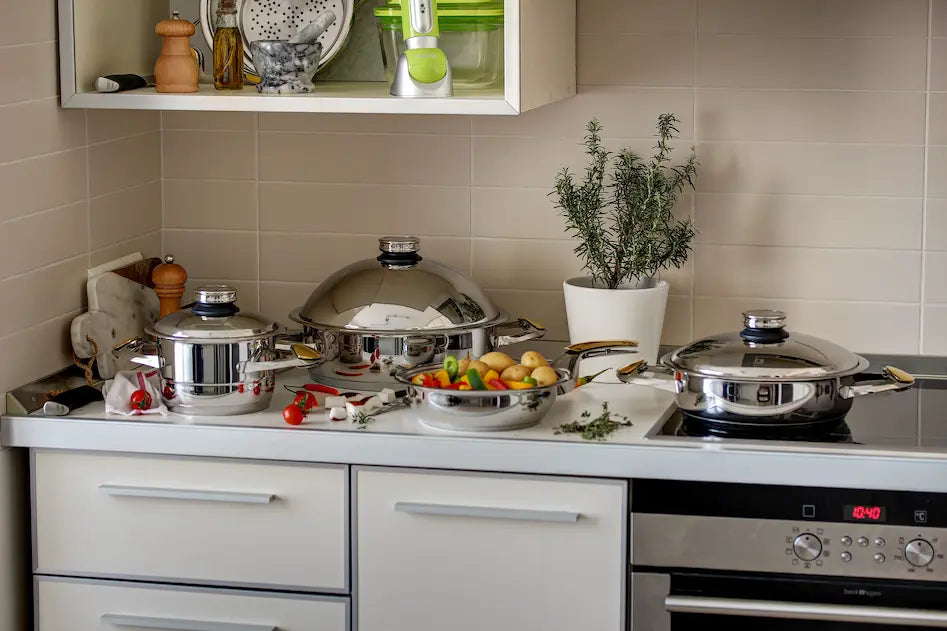


Induction Hob Cookware in NZ: What Works and How to Choose

Quick answer: Induction hobs need cookware with a magnetic base. The simplest check is the magnet test: if a magnet sticks firmly to the bottom, it should work. Choose flat-bottom pans that match your hob zone size and prioritise durable materials like stainless steel or cast iron for even heating.
Shopping for induction hob cookware can feel confusing because pans that look identical can behave very differently on an induction cooktop. The good news is that compatibility is easy to check, and once you know what to look for, choosing the right pots and pans becomes straightforward.
In this guide we explain what makes cookware induction-ready, which materials perform best, what to avoid, and how to build a practical set for NZ kitchens. If you want to browse compatible options first, start here: induction cookware collection. For premium stainless cookware, you can also explore Masterpiece cookware.
How induction cooking works (in plain terms)
Induction hobs heat the pan, not the glass surface. A magnetic field under the hob causes compatible cookware to heat up directly. That is why induction is fast, responsive, and efficient, but only if the pan base is magnetic and makes good contact with the cooking zone.
What cookware works on an induction hob?
Induction works best with cookware that has a ferromagnetic base and a flat, stable bottom. Common induction-friendly options include:
- Magnetic stainless steel (often multi-layer or with an induction base)
- Cast iron and enamelled cast iron
- Carbon steel
- Some aluminium or copper pans that have an added magnetic base plate
Some cookware is labelled 'induction ready' or shows an induction coil icon. That can be helpful, but we still recommend doing a quick compatibility check yourself, especially if you are buying older cookware or second-hand.
The magnet test: the fastest way to check compatibility
Grab a fridge magnet and place it on the bottom of the pan:
- If it sticks firmly: the pan should work on induction.
- If it barely clings or falls off: it may not work well or may not work at all.
- If it does not stick: it is not induction compatible.
Tip: check the base rather than the sides. Some pans have non-magnetic bodies with a magnetic base plate.
What to look for when buying induction hob cookware in NZ
1) A flat base that matches your cooking zone
Induction zones work best when the pan base closely matches the active zone size. If the base is too small, the hob may not detect it reliably. If it is much larger than the zone, heating can feel uneven.
2) Enough weight for stability (but not so heavy you avoid using it)
Heavier cookware often sits flatter and can heat more evenly. Cast iron is a classic example, but a well-made stainless pan with a solid base can also perform extremely well. The right balance is the pan you will reach for every day.
3) Construction that supports even heating
Look for terms like multi-layer, encapsulated base, or layered construction. The goal is a base that spreads heat across the cooking surface so you do not get hot spots in the centre.
4) Handles, lids, and everyday usability
Small details matter in real cooking. Comfortable handles, a well-fitting lid, and an easy-to-clean rim can be the difference between a pan you love and one that stays in the cupboard.
5) Scratch awareness for glass tops
Induction hobs usually have a glass surface. Many pans are perfectly safe to use, but grit trapped under the base can scratch. We recommend wiping the hob and the pan base before cooking, and lifting rather than dragging cookware.
Best materials for induction cookware
Stainless steel
Stainless steel is a popular all-round option. For induction, the key is that the stainless base must be magnetic, or the pan must include a magnetic layer. Quality stainless cookware can be durable, easy to maintain, and great for browning and pan sauces.
Cast iron and enamelled cast iron
Cast iron is naturally induction compatible and holds heat well. It can be ideal for searing and slow cooking. The trade-off is weight, and the need to be careful with the hob surface. Enamelled cast iron reduces the seasoning maintenance but is still heavy.
Carbon steel
Carbon steel pans can be excellent for high-heat cooking and develop a natural non-stick surface over time. They are lighter than cast iron and usually induction compatible. Like cast iron, they benefit from seasoning and care to avoid rust.
Non-stick pans
Non-stick can be convenient, especially for eggs and delicate foods. If you choose non-stick for induction, look for a strong base and avoid overheating. We recommend using moderate heat and replacing non-stick pans when the coating is worn.
Common induction cookware problems (and how to fix them)
The hob says 'no pan' or keeps switching off
- Check the magnet test again and confirm the base is magnetic.
- Make sure the pan base is large enough for the zone.
- Centre the pan on the zone and keep the base flat to the glass.
Heating feels uneven
- Use a pan with a thicker base or multi-layer construction.
- Match the pan base to the zone size more closely.
- Reduce extreme heat settings and allow a short preheat.
The pan rocks or spins
That usually means the base is warped or not truly flat. Warping is more common with very thin pans or when a hot pan is cooled too quickly. A stable, well-built base helps avoid this.
Do you need an induction adapter plate?
An induction adapter plate is a magnetic disc placed between the hob and a non-compatible pan. It can be a workaround, but it adds another layer, slows heating, and can reduce the main benefit of induction. If you cook on induction often, we usually recommend investing in at least a few core induction-ready pieces instead.
If you are building a set from scratch, our overview page is a helpful starting point: cookware for induction cooktop.
Our simple starter set for an induction hob
You do not need a 12-piece set to cook well. A practical starter kit for many NZ homes is:
- 24 to 28 cm frypan
- 18 to 20 cm saucepan with lid
- 24 cm sauté pan or deeper pan with lid
- Stockpot if you make soups, pasta, or batch meals
Start with the pieces you use most. Then add specialty items once you know your cooking patterns.
How to care for induction cookware
Good cookware can last for years if you treat it well. These habits help:
- Avoid thermal shock: do not plunge a very hot pan into cold water. Let it cool first to reduce the risk of warping.
- Use the right heat: induction can ramp quickly. Start at a lower setting and increase as needed, especially with non-stick.
- Choose suitable utensils: wooden, silicone, or nylon tools can reduce scratching, especially on coated pans.
- Clean gently: for stainless steel, a non-abrasive sponge and warm soapy water is usually enough. For stuck-on food, soak rather than scrape.
- Dry and store well: dry pans fully before stacking. If you stack, use a cloth or pan protector between pieces.
Buying tips for NZ kitchens
When we help customers choose cookware in NZ, we also look beyond the pan itself:
- Local availability of replacements: lids and spare parts are easier when the range is stocked in NZ.
- Warranty and support: if you are investing in premium cookware, clear warranty terms and responsive support matter.
- Your cooktop layout: some NZ induction hobs have bridge zones or flexible zones. If you do, consider cookware shapes that fit that layout.
FAQs
What cookware works on an induction hob?
Cookware with a magnetic, flat base works on induction. Magnetic stainless steel, cast iron, carbon steel, and some aluminium or copper pans with a magnetic base plate are common options.
How can I tell if my cookware is induction compatible?
Use the magnet test. If a magnet sticks firmly to the bottom of the pan, it should work on an induction cooktop. If it does not stick, the pan is not compatible.
Is stainless steel or cast iron better for induction?
Both can perform very well. Stainless steel is usually lighter and versatile for everyday cooking, while cast iron holds heat strongly and is excellent for searing and slow cooking. The best choice depends on what you cook and what you are comfortable lifting and handling.
Can I use non-induction pans on an induction hob with an adapter?
Sometimes. An adapter plate can allow some non-compatible pans to heat, but it is slower and less efficient than using induction-ready cookware. If you use induction often, investing in a few compatible core pans is usually the better long-term option.
What size pan should I use on an induction zone?
Choose a pan with a base that closely matches the zone size. If the base is too small, the hob may not detect it reliably. If it is much larger than the zone, heating can be less even.
How do I stop induction pans from scratching the hob?
Wipe the hob and the pan base before cooking, lift cookware rather than dragging it, and avoid sliding gritty or dusty bases across the glass. Using stable pans with flat bases also helps.
Next steps
- Shop induction cookware
- Explore Masterpiece cookware
- Cookware for induction cooktop
- Induction cookware
- Induction cooktop pans
- Saucepans for induction cooktop
- Induction ready cookware