




PFAS-Free Cookware NZ: Choosing for the Years, Not Just the First Few Meals

The useful test happens later. Bringing home a new pan is easy to feel good about. The surface is perfect, the base is flat, the handle feels solid and the label says the things you hoped it would say. But the more useful question is the one your future self will ask after hundreds of breakfasts, weeknight dinners and slow Sunday lunches: do you still understand what your food is touching, trust how the pan is wearing and enjoy cooking with it?
If you are looking for PFAS free cookware NZ options, the label is a useful starting point, but it is not the whole ownership story. PFAS refers to a broad family of chemicals. PFOA is one member of that family, so PFOA-free is a narrower claim. PTFE is also classified within PFAS by current authorities. That means a PFOA-free label alone does not establish that cookware is PFAS-free.
That is why we like to look past the front of the box. With MasterPiece Cookware, we care about the construction you can understand on day one and the cooking performance you can keep getting to know over time.
The label tells you one thing. The cooking surface tells you more.
PFAS is short for per- and polyfluoroalkyl substances, a very large group of synthetic chemicals. PFOA sits within that group. PTFE, the fluoropolymer commonly used for conventional non-stick cookware, is also classified within PFAS by current Health Canada and German Federal Institute for Risk Assessment guidance.
So when you see PFOA free cookware NZ, read the words literally. It tells you something about PFOA. It does not automatically tell you whether PTFE or another PFAS is present. A search for cookware without PFAS NZ can surface several different labels, so look for a clear statement about the actual cooking surface and materials rather than assuming one label covers the whole chemical family.
There is also no need for scare language. Current risk-assessment guidance does not say that properly used PTFE cookware automatically causes harm. The BfR says adverse health effects are not expected when PTFE-coated cookware is used as intended and not overheated. The practical point is simpler: if you personally prefer to avoid PFAS-style non-stick coatings, know exactly what claim you are buying.
If you want a broader look at materials and terminology, our guide to non toxic cookware NZ covers that question without turning every material into a good-or-bad label.
Day one: understand what your food actually touches.
A pan has more than one story. There is the body that gives it strength and shape. There is the base that meets the hob and manages heat. Then there is the inner surface that your eggs, fish, vegetables, sauces and steaks actually touch.
Those parts may be made in different ways, so it helps to ask a very plain question: what is the cooking surface?
With uncoated stainless steel cookware, food touches the metal itself. With a conventional coated non-stick pan, food touches the applied non-stick layer. If you are comparing PTFE free cookware NZ options, that food-contact surface is still worth checking. Neither description tells you everything about how a pan will cook, but it tells you something important about what you are learning to use and care for.
We think that clarity matters. A pan should make sense in your hands. You should know why it responds to a certain heat level, what part of the construction is doing the work and what sort of care the surface needs. That is part of the reason we value the MasterPiece approach: durable metal construction and heat control are not hidden extras. They are central to how the cookware is intended to be used.
After hundreds of meals: what still matters?
The day-one label is fixed. Ownership is not.
Months and years later, what you notice is how the pan behaves on a Tuesday night when you are hungry and just want dinner to work. Does the heat still feel predictable? Does the base still sit properly and give you confidence on the hob? Can you use sensible care without feeling as though every meal is a threat to the surface?
You also start to notice whether the cooking surface depends on a separate layer that has its own wear limits, or whether the surface is the metal itself. That difference can change how you think about marks, utensils, cleaning and the point at which a pan feels old.
This is where the idea of buying for years becomes more useful than buying for the first few meals. Good long-term cookware should become more familiar, not more mysterious. You learn how much heat it needs. You learn when food will release. You learn how to clean it after a sticky sauce or a hard sear. The pan becomes something you know, rather than something you are constantly second-guessing.
And your own cooking matters more than any fashionable label. A family making omelettes and stir-fries most nights needs something different from a household that mostly braises, simmers and roasts. If a PFAS-free frying pan NZ search brought you here, think about the meals you actually cook and whether the surface and heat behaviour will still suit those meals after the novelty has worn off.
Where stainless steel changes the ownership story.
An uncoated stainless steel cooking surface gives you a different ownership experience from cookware that relies on a conventional applied non-stick layer. The surface you learn is the metal surface itself. That does not make food magically release without technique, but it does mean there is no conventional applied non-stick layer doing the separating between your food and the pan.
That changes what long-term ownership can feel like. Rather than trying to preserve the original slipperiness of an applied layer, you focus on heat control, timing and sensible cleaning. Once those habits become familiar, stainless steel can feel reassuringly straightforward.
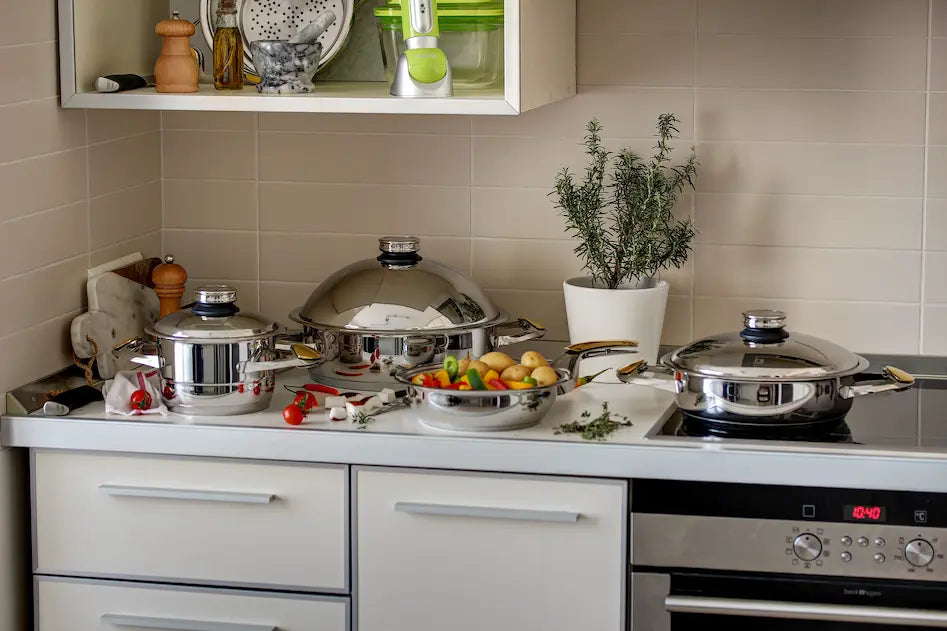
Our 24 cm Zepter URA frying pan with lid is an unusual example. It is made in Italy from AISI 316L-304 steel, has a 24 cm diameter and 2.5 L capacity, and is suitable for both the oven and dishwasher. Its Accuthermal Compact Bottom is designed for all heat sources, including induction.
URA is different from a conventional applied non-stick coating. The inner metal surface is changed rather than having a separate conventional non-stick layer applied over it. We are careful with the wording here: we do not label this pan PFAS-free because the current NZ product information does not explicitly make that claim.
If you want the deeper technical distinction between plain stainless steel, coated non-stick and URA, see our stainless steel non-stick pan guide. The useful point for this article is ownership: knowing what the surface is, how it is made and how you are meant to cook on it gives you much more to go on than a reassuring front-label phrase.
Why we would rather sell cookware you learn once and keep using
We would rather help you learn a good pan than keep convincing you to replace one.
That is a big part of how we think about cookware. Strong metal construction matters because it gives the pan a solid foundation. Controlled heat matters because good cookware should not need to be blasted on high to prove itself. An understandable surface matters because you should know what you are cooking on and how to look after it.
The 24 cm URA frying pan brings those ideas together in a very practical size. Its 2.5 L capacity gives you room for everyday pan-frying and sautéing without turning it into an oversized piece of equipment. The AISI 316L-304 metal construction is paired with the Accuthermal Compact Bottom, so the pan is designed to work across heat sources, including induction. It can also go in the oven and dishwasher, which matters when a piece of cookware is going to earn a regular place in the kitchen rather than live carefully at the back of a cupboard.
Then there is the surface. Because URA changes the inner metal surface instead of adding a conventional separate non-stick coating, the thing you are learning to cook on is part of the metal construction itself. For us, that makes the relationship between technique and cookware easier to explain: use controlled heat, give the pan time to do its job and learn how food behaves on that surface.
Long warranty support is part of the same ownership idea. The current NZ warranty states at least 30 years for products made from the specified Zepter metal, covering defects in materials or workmanship and subject to its terms. Other parts can have different warranty periods. We like that sort of long view because it matches what premium cookware should be asking of you: not another purchase next season, but a willingness to learn one piece well and keep cooking with it.
For someone who is tired of repeatedly replacing cookware, that combination is worth considering. Not because every other pan is bad, and not because one material removes every possible concern, but because durable metal, controlled heat, a clearly explained surface and long-term support give you a more concrete reason to buy than a label alone.
Before the next pan goes in your trolley
When you are standing in front of a shelf or scrolling through PFAS free pans NZ, the most useful question is not simply whether the word PFAS-free or non-stick appears on the page. Ask yourself whether you understand the cooking surface, how the pan is meant to be used, how that fits the food you actually make and whether the construction still makes sense for the years you hope to own it.
That is the standard we would use for our own kitchen. A good purchase should get clearer with use. You should know the heat it likes, the care it needs and why the surface behaves the way it does. When those things line up, you are no longer buying only for the first meal.
If that is the kind of cookware you want to explore, our MasterPiece range is built around durable metal construction, controlled heat and long-term use.
Common questions
What does PFAS-free cookware mean?
PFAS-free cookware is cookware marketed or specified as made without the broader family of per- and polyfluoroalkyl substances in the relevant material or cooking-surface claim. Because PFAS is a broad chemical family, this is a wider statement than PFOA-free.
Is PFOA-free the same as PFAS-free?
No. PFOA is one PFAS. A PFOA-free label does not, by itself, show that a pan is free from every other PFAS, including PTFE.
Is PTFE a PFAS?
Yes. Current BfR and Health Canada guidance classifies PTFE within the PFAS family. That classification is separate from safe-use risk: BfR says adverse health effects are not expected when PTFE-coated cookware is used as intended and not overheated.
Does PFAS-free cookware have to be ceramic?
No. PFAS-free cookware can use different material approaches. Uncoated stainless steel is one example of a cooking surface that does not rely on an applied PFAS non-stick coating.
Does uncoated stainless steel use a PFAS non-stick coating?
No. By definition, an uncoated stainless steel cooking surface is the metal itself, not an applied PFAS non-stick layer.
Does Zepter URA use a conventional applied non-stick coating?
URA changes the inner metal surface rather than adding a conventional separate non-stick coating. We do not make a PFAS-free claim for the 24 cm URA pan.
References
- New Zealand Environmental Protection Authority: PFAS are forever - a complicated chemical family
- Health Canada: The safe use of cookware and bakeware
- German Federal Institute for Risk Assessment: Cookware with PTFE non-stick coating
- US Food and Drug Administration: Questions and Answers on PFAS in Food