


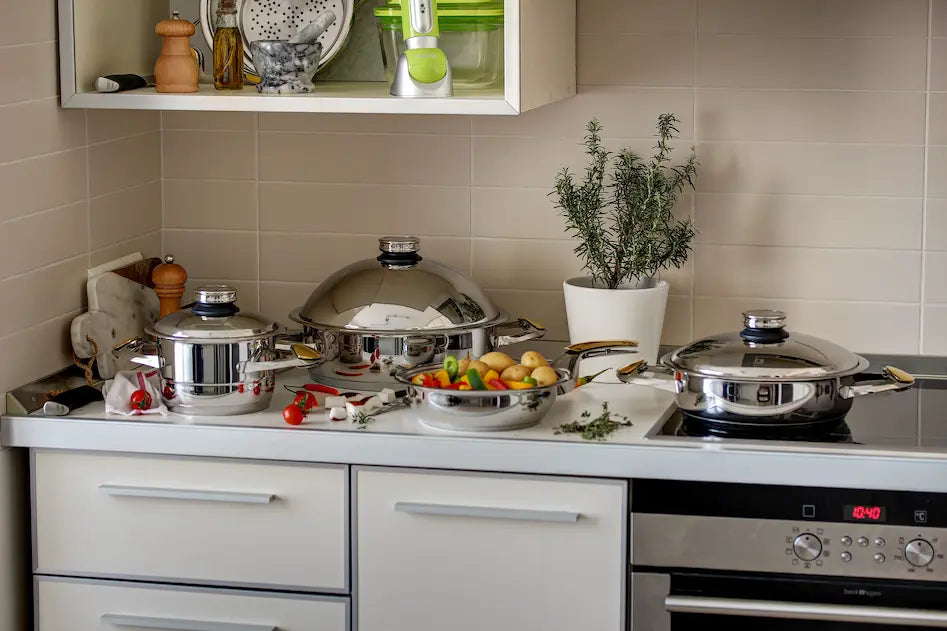


Best Cookware for a Gas Cooktop in NZ: Match the Flame, Base and Heat Control

A polished pan sits over a clean blue flame, but something is wrong. The flame is licking past the base, the handle is warming, and the centre of the food is catching before the outer edge has cooked. The pan may be labelled for gas, yet it is not well matched to that burner.
Being usable on gas is only the starting point. Good results come when the flame, cookware base and cooking job work together, then the cook reduces the heat at the right moment.
The best cookware for a gas cooktop is stable on the trivet, has a base diameter that keeps the flame underneath, transfers heat evenly, has secure handles and suits the cooking job. Choose compact pots for small burners, everyday pans or casseroles for standard burners, and broader cookware for high-output burners. Gas rewards responsive heat control, so reduce the flame once the initial heating work is complete.
Read the flame before you rate the cookware
A gas cooktop gives you a visible heat map. The pattern changes as you turn the knob, so burner choice becomes part of the cookware decision.
Burner outputs differ. Small burners suit compact pots and gentle work. Standard burners handle everyday frying, sauces and casseroles. Large or wok burners suit broader cookware, fast boiling and higher-output cooking. Your appliance manual remains the final authority.
Watch the flame, not only the knob. A small pan over a large flame can send heat around the sidewalls and towards handles. A wide pan on a small burner may heat slowly at the edges while concentrating heat in the centre. Both pieces may be gas-compatible, but poorly matched.
The three-burner kitchen audit
Do this audit while the cooktop is cold. You are collecting facts for the buying matrix, not judging cookware by appearance.
1. Small or simmer burner
- Check the burner diameter, trivet shape and stability of your smallest pot.
- List its usual jobs, such as sauces, grains, reheating or small vegetable portions.
- Note rocking, slow response or a handle that crowds another burner.
2. Standard everyday burner
- Test your most-used pan or casserole for level support and safe handle direction.
- List regular jobs, such as eggs, fish, sautéing, curries or one-pan meals.
- Note centre scorching or a pan that feels too broad for the burner.
3. Largest or wok burner
- Check trivet width, any approved wok support and clearance from nearby burners.
- Test your largest pot, pan and wok without lighting the burner.
- List the jobs: batch cooking, stock, fast boiling, stir-frying or searing.
Measure the usable space between burner centres too. Your audit should reveal the base range each burner can support, the meals assigned to it, and the pieces that rock, scorch or crowd the cooktop.
Flame-to-base failure map
| What you notice | Likely mismatch | What to change | Feature to prioritise |
|---|---|---|---|
| Flames pass the base | Burner or flame is too large | Lower the flame, change burner or use broader cookware | A base that contains the flame |
| Food catches in the centre | Broad pan over narrow, intense heat | Use a wider burner and a calmer warm-up | An even, substantial base |
| Wide cookware heats slowly | Burner is too small or weak | Use a larger burner or smaller format | Base size suited to burner and food load |
| Cookware rocks | Base and trivet do not sit securely | Stop and test another burner or shape while cold | A flat, level base |
| Handle meets another flame | Poor handle angle or crowded burners | Reposition it or reduce simultaneous pan size | Secure handles and safe clearance |
| Steam escapes aggressively | Flame remains too high after warm-up | Reduce heat and seat the lid correctly | A fitted lid and heat-retaining base |
| Wok feels unstable | Wok profile does not match the support | Use a flat base or approved wok support | Stable base and controllable handles |
Match each burner to a cookware job
| Burner | Cooking jobs | Cookware formats | Fit check | Typical mismatch | Collection |
|---|---|---|---|---|---|
| Small | Sauces, grains, reheating | Small pot or compact casserole | Base fully supported | Large casserole, hot centre | Explore Zepter pots |
| Standard | Sautéing, frying, curries | Frying pan or medium casserole | Centred base, clear handle | Small pan, oversized flame | Compare frying pans |
| Large | Batch meals, stock, fast boiling | Large pot, casserole or pan | Stable when full and stirred | Compact pot, sidewall flame | Browse Masterpiece Cookware |
| Wok or high-output | Stir-frying, searing, large loads | Stable flat-bottom wok | Secure empty and loaded | Round base without approved support | View Zepter woks |
Five moments when the gas flame should change
- Ignition and positioning. Light the burner correctly, then centre the cookware and set the handle direction.
- Controlled initial warm-up. Give the base time to receive and spread heat. The biggest flame is not always the fastest route to an even result.
- Active boiling, browning or searing. Use enough flame for the required action. Watch food, sound and moisture, not only the knob.
- Reduction after initial heating. Once boiling, steam or browning is established, reduce the flame before heat climbs the sides or drives moisture from the lid.
- Finishing with contained or retained heat. A fitted lid and heat-retaining base may support a calmer final stage. Timing still depends on burner output, cookware size, ingredients and quantity.
For more technique detail, read the Zepter low-heat cooking guide.
The Accuthermal Handoff: When to Turn the Flame Down
The handoff moves cooking from active direct flame to controlled heat. It is a sequence, not one universal hob setting.
- Match burner and base. Keep the flame beneath a securely supported base.
- Begin with controlled direct heat. Use enough flame to start the required cooking action.
- Watch for cues. Look for a steady simmer, active steam, developed browning, a change in sound or Thermocontrol movement where included.
- Reduce the flame. Turn it down once the initial heating work is complete.
- Let the base and lid support the next stage. Zepter describes the Accuthermal Compact Bottom as a three-layer base that distributes and retains heat. The fitted lid supports the contained moisture cycle called Closed Circle.
- Correct warning signs. Excessive steam, centre scorching or sidewall flame means you should lower the heat, re-centre the cookware or change burners.
Current NZ product information identifies Superior Metal 316L, the Accuthermal Compact Bottom and analogue Thermocontrol on selected lidded pieces. Verified pages list manufacture in Italy. The live 24 cm frying pan page states that its Accuthermal base works on all heat sources, including induction, which includes gas use. Recheck the exact product page because lids and Thermocontrols vary.
See the Masterpiece Cookware technology page, the construction guide and current Thermocontrol options.
Cold-hob fit test before buying
- Stability: Press lightly at opposite sides. The cookware should not rock.
- Centre: Position the base over the burner ring.
- Flame containment: Visualise your usual flame staying beneath the base.
- Handle direction: Keep it away from edges, controls and neighbouring flames.
- Clearance: Test another common pan beside it.
- Lid room: Check that you can fit, lift and rest the lid safely.
- Loaded lifting: Allow for food and liquid weight.
- Wok stability: Test the base before planning vigorous stirring.
Build a gas-ready trio, not another crowded set
Choose three roles from your burner audit, then select the size within each role.
Compact pot for the smallest burner
A 16 cm casserole can suit sauces, grains or small portions when the trivet supports it. The live Zepter pots collection also includes larger formats, so match the base to your small burner.
Everyday pan or casserole for the standard burner
Choose by your most frequent meal. A 24 cm pan may suit fish, eggs and sautés. A medium casserole may better suit curries, sauces and one-pot meals. Compare the live frying pan formats.
Larger pan, pot or flat-bottom wok for the largest burner
Choose for batch size or high-output work, not because bigger is always better. A 28 cm casserole may suit family meals, while a stable 24 or 30 cm wok may suit frequent stir-frying. Check current wok sizes and specifications.
A one-person household with a compact hob may choose smaller formats throughout. A batch-cooking family may need a broader casserole and large pot. Your meals, burner map and lifting comfort should decide the trio.
Gas cooktop decisions: concise FAQs
What cookware is best for a gas cooktop?
Stable cookware with a suitable base, even heat transfer, secure handles and a format matched to the burner and cooking job is best.
Can any cookware be used on a gas stove?
No. It must be approved for gas or open-flame use, stable on the trivet and suitable for the heat pattern.
Is stainless steel cookware good for gas cooktops?
Yes. Well-constructed stainless steel is durable and responsive, but base construction and burner match still determine performance.
Do gas cooktops need flat-bottom pans?
Flat bottoms are usually most stable on standard trivets. Use a round-bottom wok only with a support approved for that cooktop.
How should pan size match a gas burner?
Choose a base wide enough to contain the flame while remaining fully supported. Avoid very wide pans on narrow burners and small pans over large flames.
Should the flame reach around the sides of a pan?
No. Keep the flame beneath the base to avoid wasted heat, hot handles and an uneven cooking pattern.
Why does food burn in the centre on a gas stove?
A narrow or intense burner may concentrate heat in the middle. Reduce the flame, warm more gradually or change burners.
Is a flat-bottom wok better for a gas cooktop?
It is often more stable on a standard trivet. A round-bottom wok needs a suitable approved support.
When should I turn the gas flame down with Zepter Masterpiece cookware?
Turn it down when simmering, steam or browning is established. Use food cues and Thermocontrol where included, then let the Accuthermal base and lid support steadier cooking.
Choose by flame, base and heat control
The best cookware for a gas cooktop in NZ is not simply marked gas-compatible. It sits securely, keeps the flame beneath its base and suits the meal.
Use the audit to identify your size range, the failure map to diagnose poor matches, and the matrix to choose only the roles your kitchen needs. Browse the Masterpiece Cookware collection by size and cooking job, then use responsive heat control and the Accuthermal handoff for more consistent cooking.