


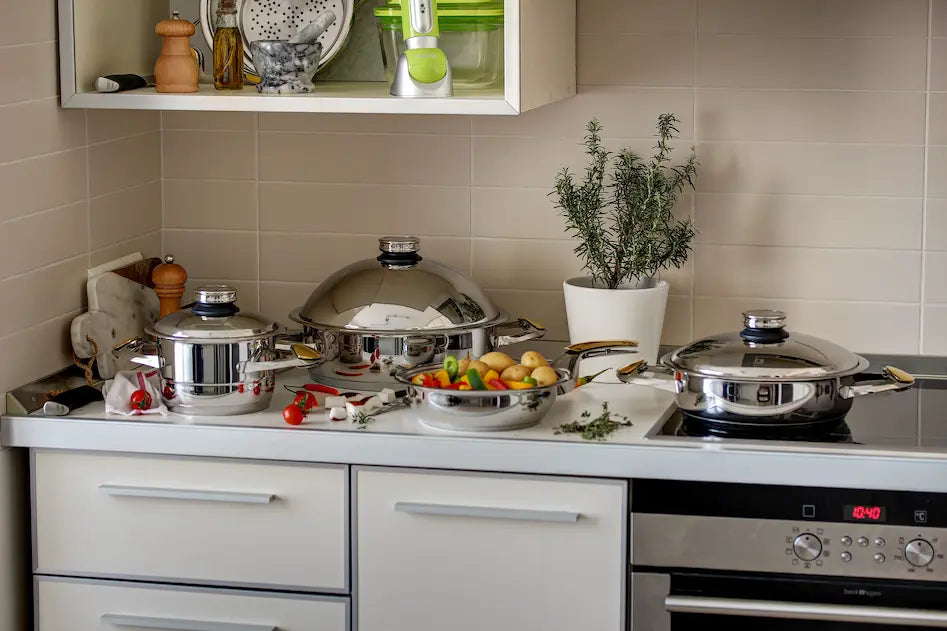


Best Cookware for Ceramic Cooktops NZ: Flat-Base, Scratch-Safe Buying Guide

A new ceramic or glass cooktop can make a kitchen feel instantly cleaner and more modern. Then the first heavy pan wobbles, the base leaves a faint mark, or a bit of grit scratches under the pan, and cooking starts to feel more stressful than it should.
Direct answer: the best cookware for ceramic cooktop NZ kitchens has a flat smooth base, stable weight, even heat spread, a clean underside, a base diameter that suits the hob zone, and non-abrasive handling. For most everyday meals, stainless steel cookware with a quality heat-spreading base is a strong choice, while smooth non-stick, flat-bottom aluminium, carbon steel and carefully handled enamelled cast iron can also suit the job.
Think of ceramic cooktop cookware NZ buying as a contact problem first, then a cooking problem. The pan has to sit flat before it can cook well.
Why ceramic and glass cooktops need different cookware thinking
A ceramic or glass smooth-top cooktop does not have raised trivets or gas flames wrapping around the pan. Heat passes through a flat glass-ceramic surface into the base of the cookware. That makes base contact more important than it might be on gas.
If the pan rocks, bows, has a ridged base or carries dried food underneath, you lose good contact. The result can be slow boiling, hot and cool patches, baked-on spills, or marks that look like scratches. Smooth-top cooking rewards moderate heat, patient preheating and cookware that fits the zone.
It also rewards clean habits. A tiny salt crystal, herb stem or burnt-on smear trapped between glass and pan can act like an abrasive when the pan moves. That is why scratch safe cookware for glass cooktop use is not only about material. It is also about how you move, heat and clean it.
The ceramic cooktop risk triage
Use this quick triage before you blame the cooktop or the recipe.
| Risk | What it looks like | Best response |
|---|---|---|
| Scratch risk | Grit, rough bases, dragging pans or abrasive cleaning | Wipe both surfaces, lift pans and use non-abrasive cleaning |
| Wobble risk | The pan rocks or spins instead of sitting still | Replace warped cookware with a flat base cookware option |
| Heat-spread risk | Food browns in one ring and stays pale elsewhere | Choose a thicker base and match the pan to the element size |
| Cleaning risk | Spills bake hard onto the glass | Cook with controlled heat and clean spills using ceramic-safe methods |
| Oversized pan risk | The base overhangs the cooking zone by too much | Use a base that closely matches the active hob zone |
Flat-base contact checklist
Before buying new glass cooktop cookware NZ households can use daily, do these five checks.
1. Bench test
Place the pan on a flat bench. Press lightly on opposite sides. A good pan should feel settled, not springy or tilted.
2. Wobble test
Set the empty pan on a cool hob zone and tap the handle gently. If the pan rocks, it may heat unevenly and feel unsafe when stirring.
3. Clean-base check
Run your hand carefully over the underside when the pan is cool. It should feel smooth, not gritty, ridged, rusty or chipped.
4. Diameter check
Compare the actual base, not the top rim, with the ceramic zone. The base is the part doing the work. A small pan on a large zone wastes heat. A very large pan on a small zone can cook unevenly.
5. Weight check
Choose enough weight for stability, but not so much that you are tempted to drag it. A family pot full of soup is much heavier than it feels empty in store.
Scratch-safe material and handling map
No cookware is scratch-proof on a ceramic surface if grit, dragging or impact is involved. The aim is a smooth base plus calm handling.
| Cookware type | Fit for ceramic cooktops | Handling note |
|---|---|---|
| Stainless steel cookware ceramic cooktop use | Excellent when the base is flat, smooth and heat-spreading | Preheat gradually and avoid sliding |
| Quality non-stick pan | Useful for eggs, fish and delicate foods | Use moderate heat and check that the outer base stays clean |
| Flat-bottom aluminium | Good heat response if the base is smooth and heavy enough | Watch for residue or marks from softer metals |
| Carbon steel | Can work well when flat and well maintained | Lift, do not shake across the glass |
| Cast iron | Possible with care, especially if the base is flat and smooth | Place gently, avoid dropping and lift every time |
| Enamelled cast iron | Possible if the enamel base is smooth and undamaged | Do not boil dry and avoid hard impact |
| Rough unfinished bases | Poor choice for smooth glass | High scratch and mark risk |
| Warped pans | Poor choice for ceramic hob cookware NZ use | Wobble, uneven heat and poor contact |
Match the pan to the meal, not just the cooktop
The best pans for ceramic cooktop use are the ones that fit both the hob and the food. A large deep pan may be perfect for chicken pieces, but clumsy for a two-egg breakfast. A compact pan may be lovely for fish, but too small for a family mince sauce.
| Meal job | Cookware choice | Why it helps |
|---|---|---|
| Eggs | Small smooth non-stick or URA-style frying pan | Gentle heat, easy release and less scraping |
| Fish fillets | Low-sided pan with even heat | Better control and easier turning |
| Vegetables | Frying pan, sauté pan or flat-bottom wok | Room to move food without shaking the pan across glass |
| Sauces | Thick-base pot or casserole | More stable simmering and fewer hot spots |
| Soups and curries | Deep pot matched to the zone | Stable weight and controlled simmering |
| Family one-pan meals | Wider frying pan or casserole with lid | Space for browning, then covered gentle cooking |
| Wok-style meals | Flat-bottom wok only | Round-bottom woks do not contact a smooth hob properly |
Zepter Masterpiece piece fit map
The Zepter Masterpiece Cookware collection is most useful when you choose by meal job and base contact, not by pan name alone. Start with the dishes you cook most often, then match diameter, depth and lid use.
| You cook most | Zepter pathway | Buying logic for a ceramic cooktop |
|---|---|---|
| Eggs, fish and small portions | 20 cm non-stick URA pan with lid | Compact base, controlled heat and useful lid discipline for gentle cooking |
| Chicken pieces, vegetables and larger fry-ups | 24 cm URA frying pan with lid or the frying pans range | A wider base gives more cooking room while still needing a close zone match |
| Soups, pasta, rice, curries and family meals | 5.0 litre 20 cm pot or the pots range | Deep volume suits simmering, but the base still needs to match the hob zone |
| Stir-fry style cooking | flat-bottom Zepter woks | Choose flat-bottom contact rather than a traditional round-bottom wok |
For a ceramic cooktop, the simplest upgrade path is usually one daily frying pan, one properly sized pot and, if you cook stir-fry meals often, a flat-bottom wok.
The Flat-Base and Lid-Seal Test
This is the Cookwares way to judge a Zepter pot, frying pan or wok for a smooth ceramic cooktop. It keeps the buying decision practical.
Base contact
Look for a base that sits flat and feels settled on the glass. Zepter Masterpiece pieces are built around the Accuthermal Compact Bottom, which is designed to retain and spread heat. On a ceramic cooktop, that only helps fully when the base is clean, flat and matched to the zone.
Hob-zone match
Check the diameter shown on the product page and compare it with your most-used cooking zones. A 20 cm pot suits different jobs from a 24 cm frying pan. Bigger is not always better if the hob zone cannot heat the base evenly.
Clean underside
Before each use, wipe the underside. Zepter low-temperature cooking is about control, so do not let old oil, salt or starch turn into a gritty layer between steel and glass.
Controlled heat
The Masterpiece Cookware method focuses on controlled, lower-temperature cooking. That can reduce the need to blast heat on a ceramic hob, especially when you preheat patiently and then reduce the setting once the base has accumulated heat.
Lid discipline
Zepter pieces with lids are designed around the Closed Circle approach, where the lid and edge support cooking in the food's own moisture. The Cookware Secret guide explains the system in more detail. On a ceramic cooktop, a lid also helps you use lower settings, but do not place a hot lid directly on the glass surface.
Thermocontrol awareness
Where a piece includes Thermocontrol, treat it as a guide for technique, not a reason to walk away. Smooth-top cooking still needs supervision, especially with milk, rice, sauces, sugar, or anything likely to boil over.
Before, during and after cooking care routine
Before cooking
- Wipe the cooktop and the pan base before switching the hob on.
- Choose the closest matching hob zone for the base.
- Start with moderate heat rather than maximum heat.
- Check that the pan sits still before adding food.
During cooking
- Lift cookware rather than sliding it across the glass.
- Avoid dragging heavy pots, especially when full.
- Do not shake a pan on the surface as you might on gas.
- Avoid overheating empty pans, particularly non-stick or enamelled cookware.
- Turn the heat down once the pan is hot and let the base do its work.
After cooking
- Move cookware to a trivet when safe to do so.
- Let pans cool before cleaning where the cookware instructions require it.
- Use non-abrasive cleaning methods on the glass.
- Remove sugary spills promptly and carefully because they can mark ceramic glass if left to harden.
- Check the pan base before storing so the next cook starts clean.
Final buying checkpoints for NZ kitchens
Before choosing the best cookware for ceramic cooktop NZ use, ask these questions.
- Does the base sit flat on a bench and on the cool hob?
- Is the underside smooth enough for glass cooktop use?
- Does the base diameter suit the cooking zones you actually use?
- Is the pan heavy enough to feel stable, but easy enough to lift?
- Does the piece fit the meals you cook weekly?
- Can you use it with controlled heat rather than constantly turning the hob to high?
- Will the lid help you simmer, steam or finish food gently?
When those answers line up, cookware feels easier on a ceramic hob. Browse the Masterpiece range by meal job, then choose the piece that gives you the best base contact for your cooktop.
FAQs
What cookware is best for a ceramic cooktop in NZ?
The best cookware for a ceramic cooktop in NZ has a flat smooth base, stable medium-to-heavy weight, even heat spread, clean underside and base diameter that closely matches the cooking zone. Stainless steel with a quality base is a strong everyday option.
Can stainless steel cookware be used on a ceramic cooktop?
Yes. Stainless steel cookware can be used on a ceramic cooktop when the base is smooth, flat and clean. For better results, choose stainless steel cookware with a thick bonded or multi-layer base that spreads heat evenly.
What pans should not be used on a ceramic or glass cooktop?
Avoid pans with rough, warped, ribbed, dented or dirty bases. Be cautious with heavy cast iron or enamelled cast iron, especially if the base is rough, because dragging or dropping can mark or damage the glass.
How do I stop cookware scratching a ceramic cooktop?
You cannot guarantee zero scratches, but you can reduce risk by cleaning the cooktop and pan base before cooking, using smooth flat-bottom cookware, lifting rather than sliding pans, avoiding abrasive cleaners and removing grit before it is trapped under the base.
Do ceramic cooktops need flat-bottom pans?
Yes. Ceramic cooktops need flat-bottom pans because the pan base must make even contact with the glass surface. A warped or rounded base can wobble, heat unevenly and make cooking less predictable.
Can induction cookware be used on a ceramic cooktop?
Usually yes, if the induction cookware has a flat smooth base and the maker says it is suitable for ceramic or electric smooth-top use. Ceramic cooktops do not require magnetic cookware, so the magnet test is not the main decision.
Is cast iron safe on a ceramic cooktop?
Cast iron can be used with care if it has a flat smooth base and is placed gently. Because it is heavy and can have a rough underside, lift it instead of sliding, avoid shaking it on the glass and follow your appliance maker's guidance.
What size pan should I use on a ceramic cooktop?
Use a pan base that closely matches the cooking zone. A slightly larger base can work on many radiant smooth-top cooktops, but avoid large overhangs because heat spread can become uneven and spills may bake onto the surface.